Conference: 17 - 2008 Case: 4 Nasal turbinates, haired skin & bone - Pig
Signalment:
Suckling pig, about 4 weeks of age, female, porcine, breed unspecified (<i>Sus domestica</i>)
Gross Description:
Multiple tongue erosions, yellowish secretion from the nose, yellowish plaques on nasal turbinates.
History:
Reduced weight gain within the herd. Suckling pigs show heavy breathing and die unexpectedly.
Histopathologic Description:
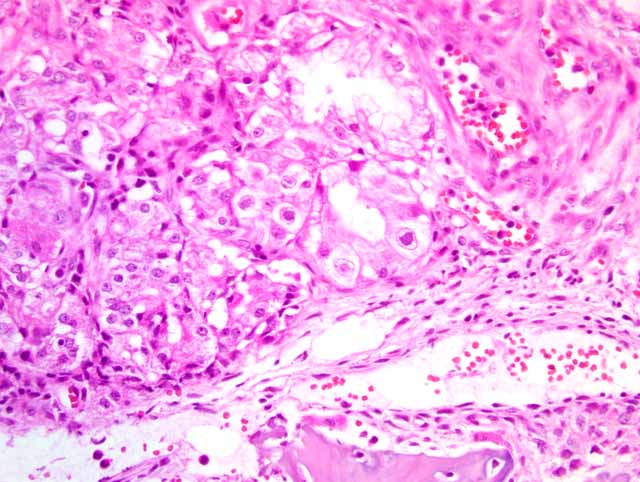
Nasal turbinate: Diffusely, the subepithelial connective tissue is expanded and infiltrated by numerous lymphocytes, plasma cells, and fewer macrophages. Epithelial cells of the nasal mucous glands and the respiratory epithelium are multifocally slightly enlarged (cytomegaly) with abundant, foamy, eosinophilic cytoplasm and a single 20-30 μm, basophilic, irregular, smudgy and granular, intranuclear inclusion body (<b>Fig. 4-1</b>) that fills and distends the karyomegalic nucleus. Multifocally the mucous glands are ectactic, lined by attenuated epithelium, and contain variable amounts of eosinophilic cellular and karyorrhectic debris (necrosis) with rare neutrophils. The respiratory epithelium is multifocally lost and replaced by a moderate amount of karyorrhectic and pyknotic cell debris (necrosis). In the nasal passage, there is an exudate composed of erythrocytes, sloughed epithelial cells, and some slightly eosinophilic material (mucous).
<br><br>
There is a large focally extensive necrotic area (not included in every slide), characterized by a large amount of eosinophilic karyorrhectic and pyknotic cell debris, and bordered by an abundant amount of small and medium caliber vessels surrounded by reactive fibroblasts and collagen (granulation tissue).
Morphologic Diagnosis:
Nasal turbinate: Rhinitis, lymphoplasmacytic and necrotizing, subacute, diffuse, marked, with glandular epithelial karymegaly due to intranuclear inclusion bodies
Lab Results:
Corynebacterium spp. were isolated from the nasal turbinate.
Condition:
Porcine cytomegalovirus (inclusion body rhinitis)
Contributor Comment:
Inclusion body rhinitis porcine cytomegalovirus (PCMV)
PCMV infections are ubiquitous and occur throughout the world, but clinical disease is much less frequent. Inclusion body rhinitis is typically an acute to subacute disease of 3-5-week-old suckling piglets. Piglets exhibit fever, sneezing, catarrhal nasal exudate, shivering, and occasional dyspnoe. Morbidity is high and mortalitiy is low unless secondary bacterial infections develop. Systemic cytomegalovirus infections usually infect piglets less than 3 weeks of age. These piglets may be found dead without premonitory signs, or exhibit sneezing, lethargy, anorexia, subcutaneous edema of the jaw and tarsal joints, and dyspnea. Infection of na+�-�ve pregnant sows induces mild lethargy, anorexia, and delivery of stillborn or weak piglets. Inclusion body rhinitis is caused by PCMV, a beta-herpesvirus. Piglets commonly shed the virus soon after weaning at 3 weeks of age, suggesting that infection is usually acquired by contact with nasal secretions of infected cohorts. Other pigs, particularly those that develop generalized disease, are probably infected from the sow in the neonatal period. The virus replicates in nasal submucosal and lacrimal glands. Viremia develops at 5-14 days after infection depending on the age of the pig and leads to infection of epithelial cells in renal tubules, liver, duodenum, and elsewhere. Pulmonary alveolar and splenic macrophages may be additional sites of viral replication. Virus is shed in nasal and ocular secretions, in the urine, and in vaginal secretions of sows.(3)
<br><br>
Infection can be diagnosed by the presence of characteristic large, basophilic, intranuclear inclusion bodies in cytomegalic cells of the nasal glandular epithelium. Such inclusion bodies and mononuclear cellular infiltrations can also be detected in the tubular epithelia of the kidneys, as well as the epithelia of the salivary and tear glands. Other, less frequent, lesions include interstitial pneumonia and lymphocytic perivasculitis in the brain. Predisposing factors of the infection are not fully known. A low level of immunity within the herd, e.g., in newly established herds, and immunosuppressive effects may play a role. Seroconversion due to PCMV is probably much more frequent than clinical disease.(1) In our case, sows in the herd had problems with insufficient lactation.
<br><br>
<b>Herpesviridae</b>
<table cellspacing=0 cellpadding=5 border=1>
<tr>
<td rowspan=18 valign="top"><b> Alphaherpesvirinae</b>: focal lesions in skin and mucosa of resp. and genital tract; abortion; neonates: necrosis in multiple organs, latency in nerves</td><td> Equine herpesvirus 1: Equine herpesviral abortion, rhinopneumonitis, neurologic disease</td><td>horse</td>
</tr><tr><td> Equine herpesvirus 3: Equine coital exanthema</td><td>horse</td>
</tr><tr><td> Equine herpesvirus 4: Equine rhinopneumonitis</td><td>horse</td>
</tr><tr><td> BHV-1: infectious bovine rhinotrcheitis/infectious pustular vulvovaginitis/infectious balanoposthitis</td><td>cattle</td>
</tr><tr><td> BHV-2: bovine mammilitis virus (bovine herpes mammilitis)</td><td>cattle</td>
</tr><tr><td> BHV-5: bovine herpesvirus encephalitis</td><td>cattle</td>
</tr><tr><td> SHV-1: Aujezky-�s disease, Pseudorabies</td><td>pig > others</td>
</tr><tr><td> Canine herpesvirus 1: </td><td>dog</td>
</tr><tr><td> Feline herpesvirus 1: upper respiratory tract disease (rhinotracheitis) and conjunctivitis (ulcers)</td><td>cats</td>
</tr><tr><td> Feline herpesvirus 1: feline herpesvirus ulcerative dermatitis</td><td>cats</td>
</tr><tr><td> Gallid herpesvirus-1: Infectious laryngotracheitis (ILT)</td><td>chicken</td>
</tr><tr><td> Gallid herpesvirus-2: Marek-�s disease</td><td>chicken</td>
</tr><tr><td> Psittacine herpesvirus: Pacheco's disease</td><td> psittacines</td>
</tr><tr><td> Anatid herpesvirus-1: Duck plaque/Duck virus enteritis</td><td> ducks, geese, swan</td>
</tr><tr><td> Simplexvirus: HSV-1, HSV-2, HBV, BHV-2</td><td> </td>
</tr><tr><td> Herpesvirus simplex, type 1/type 2</td><td> human & nonhuman primates</td>
</tr><tr><td> Herpesvirus simiae/Herpes B/Cercopithecine HV</td><td> rhesus macaques</td>
</tr><tr><td> Simian varicella virus</td><td> macaques, AGM, Patas monkeys</td>
</tr>
<tr><td rowspan=3 valign="top"><b> Betaherpesvirinae:</b> no cell lysis, karyomegaly, latency in secretory glands, lymphoreticular organs, kidney</td><td> HHV-5, HHV-6, MCMV-1</td><td>humans</td>
</tr><tr><td> Porcine herpesvirus 2: porcine cytomegalovirus disease/Inclusion body rhinitis</td><td>porcine</td>
</tr><tr><td> Cytomegalovirus</td><td> humans & nonhuman primates</td>
</tr>
<tr><td rowspan=6 valign="top"><b> Gammaherpesvirinae:</b> primates: lymphoproliferative disease, latency in lymphoid tissue</td><td> EHV-2</td><td> </td>
</tr><tr><td>EHV-5</td><td> </td>
</tr><tr><td> BHV-4: bovine herpes mammary pustular dermatitis</td><td>cattle</td>
</tr><tr><td> OHV-2/AHV-1: malignant catarrhal fever</td><td>various ruminants</td>
</tr><tr><td> Epstein-Barr virus (lymphocryptovirus-gamma 1)</td><td>primates</td>
</tr><tr><td> Kaposi-sarcoma-associated herpesvirus/human herpesvirus-8 (KSHV/HHV8) (Rhadinovirus-gamma 2)</td><td>primates</td>
</tr>
<tr><td rowspan=3 valign="top"><b> Deltaherpesvirinae</b></td><td> Anatid herpesvirus-1: duck plague</td><td </td>
</tr><tr><td> SHV-2: Eischlussk+�-�rperchenkrankheit</td><td>pig</td>
</tr><tr><td> Karpfenpocken</td><td>fish</td>
</tr>
<tr><td> Uncharacterized viruses</td><td> Koi-herpesvirus (KHV, carp nephritis and gill necrosis virus, CNGV, Cyprinid-Herpesvirus-3, CyHv-3)</td><td>fish</td>
</tr>
</table>
JPC Diagnosis:
<br>
1. Nasal turbinates: Rhinitis, necro-ulcerative, subacute, diffuse, moderate, with glandular epithelial eosinophilic intranuclear inclusions <br>
2. Haired skin and bone: Necrosis, focally extensive, with granulation tissue, fibrosis, osteonecrosis and osteolysis
Conference Comment:
The contributor provides a comprehensive summary of this condition. One additional rule-out considered by attendees was atrophic rhinitis; however, changes in the nasal turbinate cartilage and bone would be an expected finding, as well the absence of inclusion bodies. For comparison purposes, a brief discussion of atrophic rhinitis is included here. Atrophic rhinitis is also a common disease in pigs worldwide. Atrophic rhinitis can be split into nonprogressive atrophic rhinitis (NPAR), caused by <i>Bordetella bronchiseptica</i>, or progressive atrophic rhinitis (PAR), caused by toxigenic <i>Pasteurella multocida</i> as a single agent or in combination with <i>Bordetella bronchiseptica</i>. Both of these disease cause hypoplasia of the nasal turbinates that clinically manifest as frequent sneezing by affected swine. Progression of either of these diseases can lead to distortion of the snout. Nasal hemorrhage is commonly seen in PAR; NPAR nasal hemorrhage is uncommon.(2)
<br><br>
Both <i>Bordetella bronchiseptica</i> and <i>Pasteurella multocida</i> produce their own toxins, and the severity of disease is dependent on the amount of toxin absorbed. One major difference between these two organisms is the age of affected pigs. PAR can affect pigs older than 3 months of age, whereas NPAR normally only affects pigs up to 6 weeks of age.(2)
<br><br>
Gross lesions in PAR are restricted to the nasal cavity and adjacent bone with the ventral scrolls of the nasal turbinates most often suffering the worst lesions. Histologically, the pathognomonic lesion of PAR is replacement of the bony plates of the ventral conchae with fibrous tissue. Metaplasia of adjacent respiratory epithelium is also common.(2)
References:
1. Deim Z, Glavits R, Biksi I, Dencso L, Raczne AM: Inclusion body rhinitis in pigs in Hungary. Vet Rec. <b>158(24)</b>:832-4, 2006
<br>
2. De Jong MF:Progressive and nonprogressive atrophic rhinitis. <i>In</i>: Diseases of Swine, ed. Straw BE, Zimmerman JJ, DAllaire S, Taylor DJ, 9th ed., pp.577-602. Blackwell Publishing, 2006