Conference 23
CASE II:
Signalment:
Male, European Badger (Meles meles), Mustelidae
History:
Two badgers were found by walkers at the edge of the forest and were brought to the Zagreb Zoo. The animals very quickly developed neurological signs similar to epileptiform seizures. They were treated with fenbendazole, but within a few days they stopped responding to the therapy and were euthanized.
Gross Pathology:
Animals were in good nutritional condition. No significant pathological changes were observed macroscopically. Blood vessels of meninges and brain cortex were moderately congested.
Laboratory Results:
lmmunofluorescence test for Rabies Virus Antigen: Negative.
PCR testing for Herpesvirus was positive and sequencing showed the virus to be of badger Gammaherpesvirus.
PCR testing for Flaviviridae was negative.
Microscopic Description:
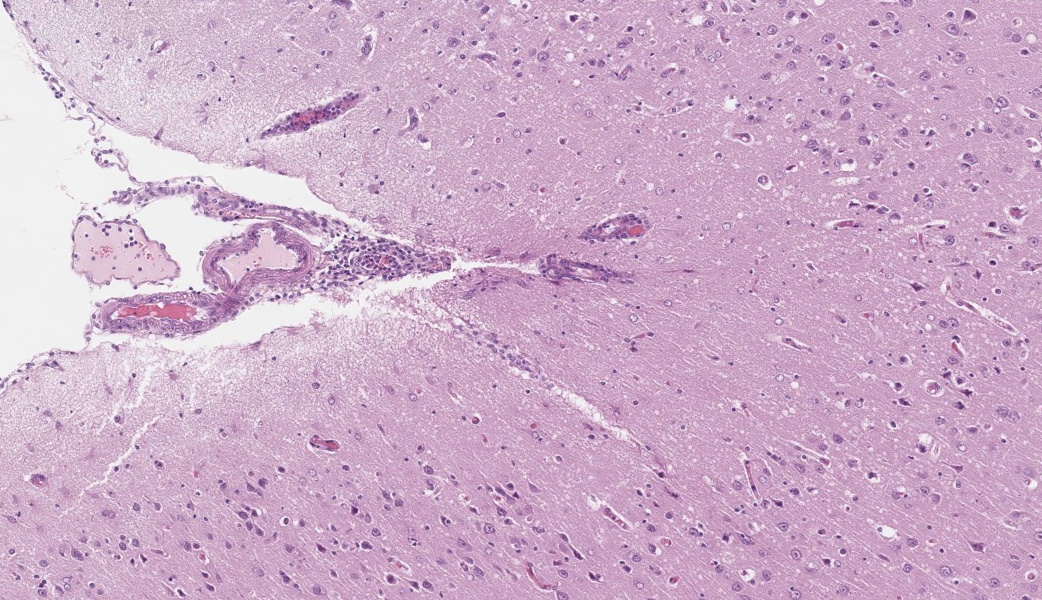
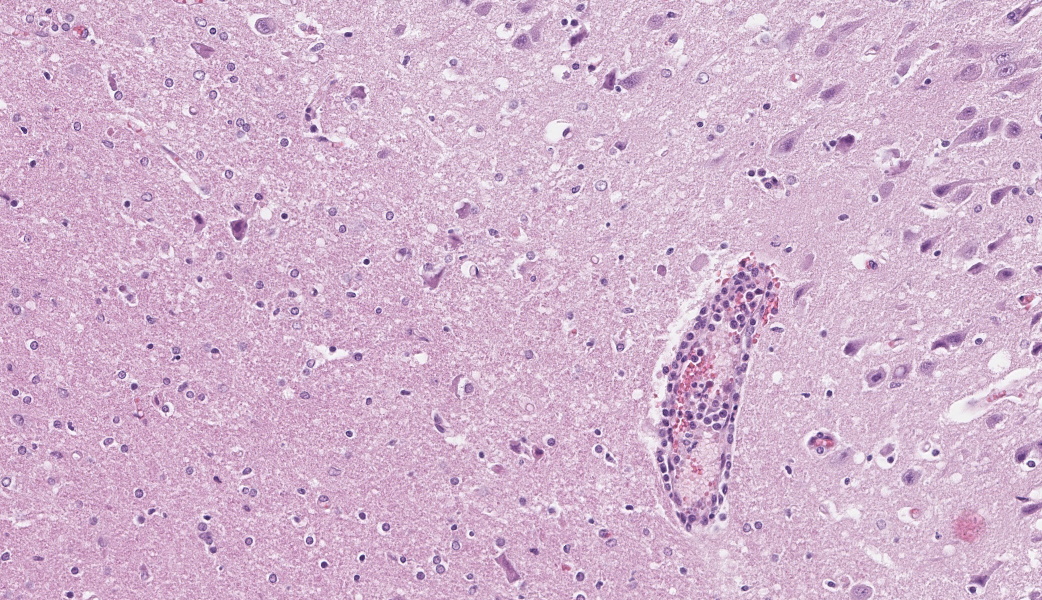
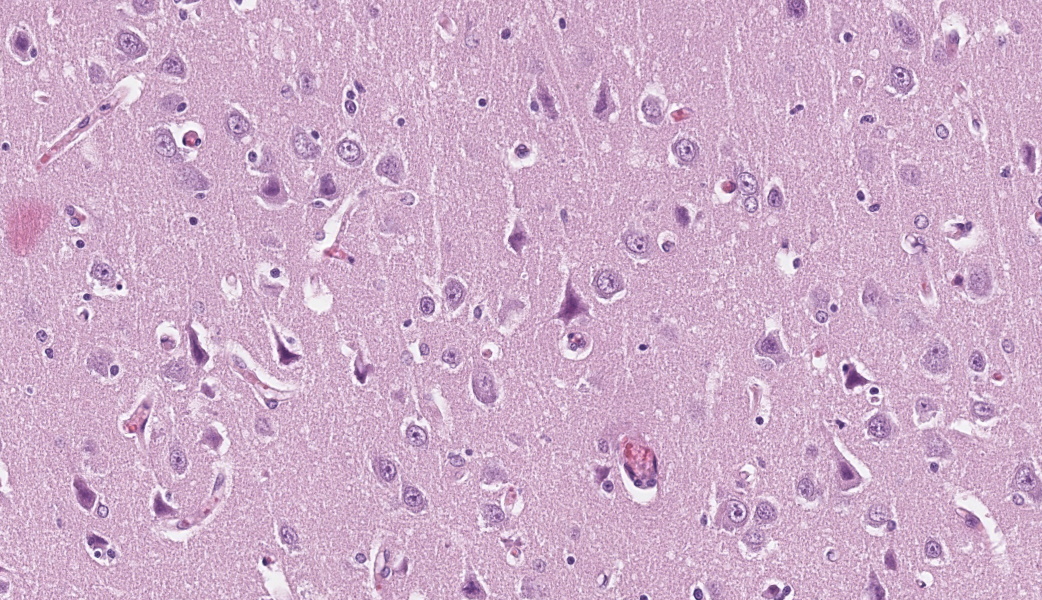
Cerebrum; multifocally affecting the meninges, the gray matter, and to a lesser extent the white matter, there is perivascular cuffing with low to moderate numbers of lymphocytes, plasma cells and fewer macrophages, that expand Virchow-Robin space up to four times normal. Within gray matter, neurons are occasionaly swollen with eosinophilic cytoplasm (degeneration), or are shrunken and angular with hypereosinophilic cytoplasm and nuclear pyknosis (necrosis). Affected neurons are occasionally surrounded by glial cells (satellitosis). Multifocally, there are small areas of hemorrhage.
Contributor Morphologic Diagnosis:
Cerebrum; Meningoencephalitis, perivascular, lymphoplasmacytic, multifocal, mild to moderate, with neuronal degeneration and necrosis, and mild hemorrhage.
Contributor's Comment:
The European badger (Meles meles), also known as the Eurasian badger, is a badger species in the family Mustelidae native to almost all of Europe and some parts of Western Asia. Literature data about diseases in this species are generally limited and mostly related to selected infections, such as bovine tuberculosis, canine distemper and rabies.1,5,9 It is also afflicted with a wide range of parasites that are mostly just a random finding and have no major impact on the badger population health.10
In recent years, it has been found that Mustelid gammaherpesvirus 1 (MusGHV-1) is circulating in the badger population in Europe.2,11,12,15 Phylogenetic analysis of sequence data demonstrates that MusHV-1 is a member of the Rhadinovirus genus within Gammaherpesvirinae closely related to equine herpesvirus 2 and 5.2,12 For the first time, it was isolated from pulmonary fibroblasts cultures established from a European badger that additionally had eosinophilic, probably verminous pneumonia, but no other obvious association to disease.2 Few later studies found high prevalence of MsGHV-1 in the genital tracts of European badgers.11,12,15 It is highly prevalent amongst wild badgers in the UK and Ireland, where MusGHV-1 DNA isolation from blood shows near 100% infection rate at some localities.14 Badgers have a highly promiscuous, polygynandrous mating system, characterized by repeated mating behavior, likely putting them at a particular risk of contracting sexually transmitted infections that possibly includes also MusGHV-1.7,13.15
Regarding meningoencephalitis, except the previously mentioned distemper and rabies, we found no data on herpesviruses as a possible cause of meningoencephalitis in badgers. In domestic animals, encephalitic herpesviruses are mostly members of the subfamily Alphaherpesvirinae, and cause cell injury through necrosis of infected neurons and glial cells, necrosis of infected endothelial cells and secondary effects of inflammation, cytokines and chemokines. However, some gammaherpesviruses can also cause lesions in the nervous system such as e.g. murid gammaherpesvirus 4, rhesus macaque rhadinovirus, ovine herpesvirus 2 in cows, and several gammaherpesviruses exist in ursine species and cause neurological lesions.3 Herpesviruses enter the CNS principally by retrograde axonal transport; however, entry by hematogenous spread via viremia and leukocytic trafficking may occur. These viruses also have a unique survival mechanism that allow them to hide in a latent form in nervous tissue, such as the trigeminal ganglion. Stress or other factors can activate latent virus, resulting in encephalitis.
Contributing Institution:
Department of Veterinary Pathology Faculty of Veterinary Medicine University of Zagreb Heinzelova 55 10000 Zagreb Croatia. http://www.vef.unizg.hr/
JPC Morphologic Diagnosis:
Cerebrum: Meningoencephalitis, lymphoplasmacytic, subacute, diffuse, mild, with neuronal necrosis, gliosis, and rare intranuclear viral inclusion bodies.
JPC Comment:
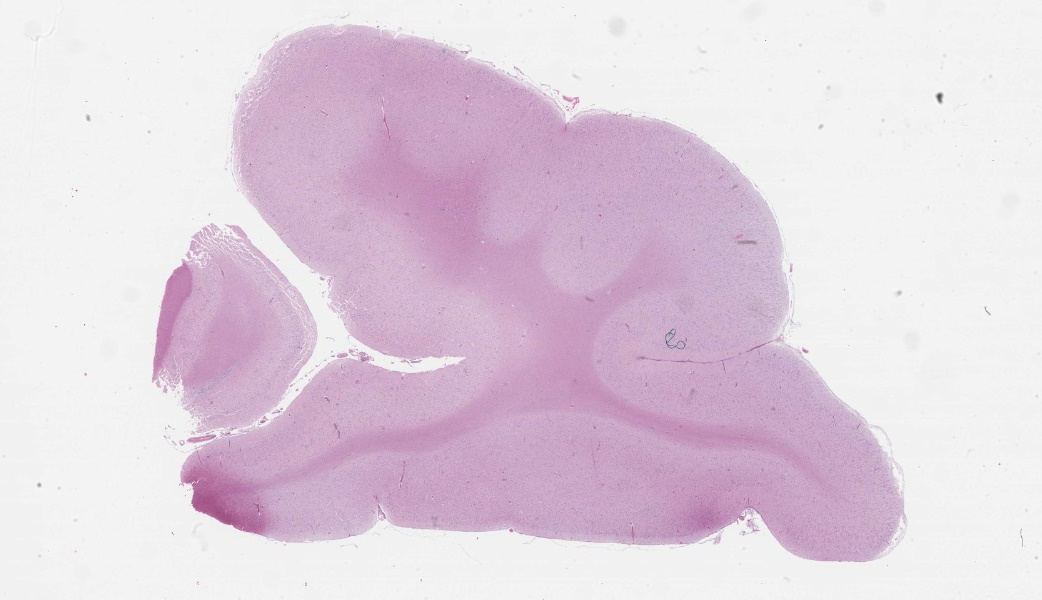
This case challenged participants with both neuroanatomic orientation and its identification as a viral meningoencephalitis, as the submitted slides varied in their anatomic level. Dr. Koehler began by anchoring everyone to two reliable landmarks on the slide that she received: the olfactory stria and the olfactory tubercle, the latter memorably described as "the wiggly bits." Conference participants, however, received a slide that included cerebrum with hippocampus and thalamus rather than the olfactory stria and tubercle. Despite variation in tissue cuts among slides, the lesions were consistent and included a multifocal lymphoplasmacytic meningoencephalitis with neuronal necrosis, edema, and perivascular cuffing, although intranuclear viral inclusions were more readily identified on the section containing thalamus.
The inflammatory pattern prompted discussion of reactive astrocytes, with Dr. Koehler emphasizing that the umbrella term "reactive astrocytes" is now preferred over attempting to subtype astrocytic morphologies.8 The constellation of dead neurons, edema, and perivascular lymphoplasmacytic cuffs strongly supported an inflammatory etiology, and herpesvirus rose quickly to the top of the differential list, along with canine distemper virus (canine morbillivirus), as this has also been reported in American badgers.4,10
Participants reviewed the biology of Mustelid gammaherpesvirus-1 (MusGHV-1), also known as Badger herpesvirus, a gammaherpesvirus in the genus Percavirus that is highly prevalent in European badgers.6 Several studies have demonstrated near-universal infection rates in some populations, with high viral loads in the genital tract.15 Combined with the badger's polygynandrous mating system, this supports sexual transmission as a major route of spread.7,15
While MusGHV-1 is widespread in European badger populations, its role in neurologic disease is less well-defined. PCR alone cannot distinguish latent from active infection, which is a key point when interpreting herpesvirus-associated lesions. Dr. Koehler noted that more definitive attribution of the lesions to MusGHV-1 would require in-situ hybridization (ISH) or virus-specific immunohistochemistry. She and other participants felt, however, that the striking eosinophilic intranuclear viral inclusions in neurons and glial cells in this case support active infection.
Participants also discussed mustelid herpesvirus-2, an alphaherpesvirus identified in sea otters that is primarily associated with ulcerative oral lesions and skin plaques, particularly in Alaskan populations.6,16 This virus is closely related to badger herpesvirus and serves as a reminder that mustelids host multiple herpesviruses with differing tissue tropisms and pathogenic potential.
References:
- Akdesir E, Origgi FC, Wimmershoff J, et al. Causes of mortality and morbidity in free-ranging mustelids in Switzerland: necropsy data from over 50 years of general health surveillance. BMC Vet Res. 2018;14:195-214.
- Banks M, King DP, Daniells C, et al. Partial characterization of a novel gammaherpesvirus isolated from a European badger (Meles meles). J GenVirol. 2002; 83:1325-1330.
- Black W, Troyer RM, Coutu J, et al. Identification of gammaherpesvirus infection in free-ranging black bears (Ursus americanus). Virus Res. 2019; 259:46-53.
- Di Sabatino D, Di Francesco G, Zaccaria G, et al. Lethal distemper in badgers (Meles meles) following epidemic in dogs and wolves. Infect Genet Evol. 2016;46:130-137.
- Donnelly CA, Wei G, Johnston WT, et al. Impacts of widespread badger culling on cattle tuberculosis: concluding analyses from a large-scale field trial. Int J Infect Dis. 2007; 11: 300-308.
- Dotto-Maurel A, Arzul I, Morga B, Chevignon G. Herpesviruses: overview of systematics, genomic complexity and life cycle. Virol J. 2025;22(1):155.
- Dugdale HI, Macdonald OW, Pope LC, et al. Polygynandry, extra-group paternity and multiple-paternity litters in European badger (Meles meles) social groups. Mol Ecol. 2007;16:5294-5306.
- Escartin C, Galea E, Lakatos A, et al. Reactive astrocyte nomenclature, definitions, and future directions. Nat Neurosci. 2021;24(3):312-325.
- Hammer AS, Dietz HH, Andersen TH, et al. Distemper virus as a cause of central nervous disease and death in badgers (Meles meles) in Denmark. Vet Rec. 2004; 154:527-530.
- Hancox M. Parasites and infectious diseases of the Eurasian badger (Meles meles): a review. Mammal Rev. 1980;10(4):151-162.
- Kent A, Ehlers B, Mendum T, et al. Genital Tract Screening Finds Widespread Infection with Mustelid Gammaherpesvirus 1 in the European Badger (Meles meles). J Wildl Dis. 2018;54(1):133-137.
- King DP, Mutukwa N, Lesellier S, et al. Detection of mustelid herpesvirus-1 infected European Badgers (Meles meles) in the British Isles. J Wildl Dis. 2004;40(1):99-102.
- Kokko H, Ranta E, Ruxton G, et al. Sexually transmitted disease and the evolution of mating systems. Evolution. 2002;56(6):1091-1100.
- Miller AD, Zachary JF. Nervous System. In: Zachary JF ed. Pathologic Basis of Veterinary Disease. 6th ed. St. Louis, MO: Elsevier; 2017:805-907.
- Tsai M, Fogarty U, Byrne AW, et al. Effects of mustelid gammaherpesvirus-1 (MusGHV-1) reactivation in European Badger (Meles meles) genital tracts on reproductive fitness. Pathogens. 2020;769.
- Tseng M, Fleetwood M, Reed A, et al. Mustelid herpesvirus-2, a novel herpes infection in northern sea otters (Enhydra lutris kenyoni). J Wildl Dis. 2012;48(1):181-185.